Gianluca Cavallo’s book Das falsche Leben: Schuld, Scham und die Grenze moralischer Freiheit has been published in German and is available from Campus (Frankfurt, New-York). Click here to access the book from the publisher’s website.
Here is a translation of the publisher’s blurb:
“There is no right life in the wrong one”: Adorno’s famous saying expresses our own entanglement in evil and bad. The subject feels guilty because he knows what he could do differently and better. But at what price? Is this price morally acceptable? Can the wrong life perhaps be justified? These are the questions that this book raises on the basis of Adorno’s reading. Since they do not allow for a clear answer, another one soon arises: How does the subject deal with this moral uncertainty? Gianluca Cavallo reconceptualises guilt and (moral) shame so that they are no longer experienced as failures, but as feelings that make the limit of our moral freedom perceptible – a limit that we should learn to accept.
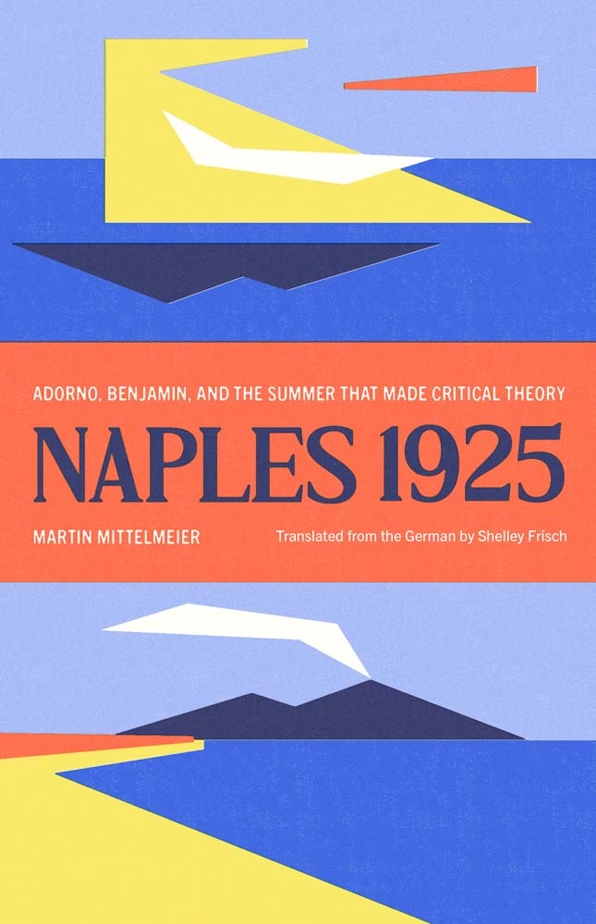
Martin Mittelmeier’s book Adorno in Neaple has been translated in English and will launch on November 12th: Naples 1925: Adorno, Benjamin, and the Summer That Made Critical Theory available from Yale University Press. Click here to access the book from the publisher’s website.
And here’s the publisher’s blurb:
In the 1920s, the Gulf of Naples was a magnet for European intellectuals in search of places as yet untouched by modernity. Among the revolutionaries, artists, and thinkers drawn to Naples were numerous scholars at a formative stage in their journeys: Walter Benjamin, Siegfried Kracauer, Alfred Sohn Rethel, Asja Lacis, Theodor W. Adorno, and many others. While all were indelibly shaped by the volcanic Neapolitan landscape, it was Benjamin who first probed the relationship between the porous landscape and the local culture. But Adorno went further, transforming his surroundings into a radical new philosophy—one that became a turning point in the modern history of the discipline.
In this ingenious book, Martin Mittelmeier reveals the Gulf of Naples as the true birthplace of the Frankfurt School. From the majestic crater rim of Mount Vesuvius to the soft volcanic rock that Neapolitans used to build their city, Mittelmeier follows Adorno’s and his fellow thinkers’ footsteps through the cities along the gulf, demonstrating how their observations and encounters surface again and again in their writings for decades to come, and serve as the structuring principle of Critical Theory.
The book received a fantastic pre-publication review just over a month ahead of publication from Kirkus Reviews, which had this to say: “Vigorous, provocative, and persuasive, Mittelmeier’s book offers original insights that will undoubtedly prove invaluable to scholars of Critical Theory. . . . An exceptionally refreshing take on the origins of the Frankfurt School.” Stanley Corngold calls the book “A rare treat. In sprightly, dancing prose, Mittelmeier constructs a convincing allegory of porosity as the cardinal feature of the volcanic rock of Naples and the structural principle of essays by the initiators of modern Critical Theory.”
The Group of Studies of Contemporary Critical Theory (GETeCC – IIGG/UBA) from Argentina and the Institute of Philosophy of the Diego Portales University (IDF – UDP) from Chile invite you to participate in the reading space on Theodor Adorno’s Negative Dialectics. The space is open to the general public and will be held fortnightly on Tuesdays, through Zoom.
Susanna Zellini wrote about her new book at De Gruyter. The full title reads Ästhetik der Form: Sprachkritik, Musik und Stil bei Nietzsche und Adorno. Here is the link to the publisher’s website and below you’ll find the publisher’s blurb:
The downfall of the systematic philosophies has raised the question of how to reconcile the radical critique of traditional forms of representation with a new need for form. This book compares the thinking of Nietzsche and Adorno along the axes of music, style, and language critique in order to reconstruct an “aesthetics of form” common to both, which proves to be an alternative to conventional twentieth-century philosophies of language.
As the readers of this blog know, the 10th meeting of the Association for Adorno Studies was held on May 30-31. The event took place on the beautiful “Pôle Citadelle” campus of the Université de Picardie Jules Verne, in Amiens, France. We owe the stunning design of the campus to the Italian architect Renzo Piano (see pictures below).
Our very heartfelt thanks go to Estelle Ferrarese and her team: Anne-Gaëlle Bled, Cassandre Caballero, Lea Gekle, Frederico Lyra, Annette de Moura and Salima Naït Ahmed, for the amazing work they did on planning and organizing this very successful meeting. This year the program was organized around a very timely theme in Adorno studies: “History and Social Theory”. It brought together a host of excellent scholars, several of whom are emerging scholars or new to the Association. Our thanks to all the presenters for their very thought-provoking and high-caliber papers on various aspects of Adorno’s views on the theme and to all the other participants who chaired sessions and partook in the lively discussions throughout the event. We counted participants from France, Italy, Belgium, Germany, the Netherlands, Sweden, Brazil, the UK, Canada and the US at this event.
As is our custom, the business meeting was held on the second day at lunch time. The main order of business was the election of a new executive. I am thrilled to announce that William Ross has accepted the role of President and Paul Dablemont that of Vice-President for a term of 3 years. Let us all thank them for their commitment to the AAS, congratulate them very warmly on their nomination and wish them the best for a very successful tenure!
Three other points of business are worth highlighting:
First, the Harvard meeting (to be hosted by Peter Gordon) has been pushed to the spring of 2026. William and Paul have been at work on a plan for 2025. They will be in touch with news about it over the summer.
Second, you can now forward information to be posted on the blog directly to William and Paul (follow the links above). They will be taking over the administration of this blog (at least until further notice).
Third, stay tuned for news about the relaunch of our journal, Adorno Studies, at Mimesis Press. It promises much!
I attach some pictures that document the event. They include pictures of the enchanting floating gardens (The Hortillonnages), a tour of which Estelle and her team had the marvellous idea to organize for us.
Peter E. Gordon published a fascinating new book on Adorno earlier this year, entitled A Precarious Happiness: Adorno and The Sources of Normativity (Chicago UP). Here‘s the link to the publisher’s website. And here’s the publisher’s blurb:
“A strikingly original account of Theodor Adorno’s work as a critique animated by happiness.
“Gordon’s confidently gripping and persistently subtle interpretation brings a new tone to the debate about Adorno’s negativism.”—Jürgen Habermas
Theodor Adorno is often portrayed as a totalizing negativist, a scowling contrarian who looked upon modern society with despair. Peter E. Gordon thinks we have this wrong: if Adorno is uncompromising in his critique, it is because he sees in modernity an unfulfilled possibility of human flourishing. In a damaged world, Gordon argues, all happiness is likewise damaged but not wholly absent. Through a comprehensive rereading of Adorno’s work, A Precarious Happiness recovers Adorno’s commitment to traces of happiness—fragments of the good amid the bad. Ultimately, Gordon argues that social criticism, while exposing falsehoods, must also cast a vision for an unrealized better world.”
Vassilis Grollios wrote about the publication of his new book at Routledge. The full title reads: Illusion and Fetishism in Critical Theory: A Study of Nietzsche, Benjamin, Castoriadis and the Situationists. Here’s the link and here the publisher’s blurb:
“Through the negative dialectics of Theodore Adorno, Illusion and Fetishism in Critical Theory offers an examination of Nietzsche, Benjamin, Castoriadis and the Situationists, who put the concept of illusion at the forefront of their philosophical thought.
Vasilis Grollios argues that these political philosophers, except Castoriadis, have up to now been wrongly considered by many scholars to be far from the line of thinking of negative dialectics, Critical Theory and the early Frankfurt School/Open Marxist tradition. He illustrates how these thinkers focused on the illusions of capitalism and attempted to show how capitalism, by its innate rationale, creates social forms that are presented as unavoidable and universal, yet are historically specific and of dubious sustainability.
Providing a unique overview of concepts including illusion, totality, fetishization, contradiction, identity thinking and dialectics, Grollios expertly reveals how their understanding of critique can help us open cracks in capitalism and radicalize democratic social practice today. Illusion and Fetishism in Critical Theory is a must read for scholars of political theory and political philosophy, critical theory, the Frankfurt School, sociology and democratic theory.”
A new translation of Adorno’s work by Douglas Robertson will soon be published at The University of Chicago Press. Here’s the publisher’s blurb:
The book “Delves into Theodor W. Adorno’s lesser-known musical career and successful music criticism.
Theodor W. Adorno is recognized as one of the twentieth century’s most prominent social theorists. Though best known for his association with the Frankfurt School of critical theory, Adorno began his career as a composer and successful music critic.
Comprehensive and illuminating, Orpheus in the Underworld centers on Adorno’s concrete and immediate engagement with musical compositions and their interpretation in the concert hall and elsewhere. Here, Adorno registers his initial encounters with the compositions of the Second Viennese School, when he had yet to integrate them into a broad aesthetics of music. Complementarily essays on Bela Bartók, Jean Sibelius, and Kurt Weill afford insight into his understanding of composers who did not fit neatly into the dialectical schema propounded in the Philosophy of New Music. Additionally, essays on recording and broadcasting show Adorno engaging with these media in a spirit that is no less productive than polemical and focused as sharply on their potentialities as on their shortcomings.
Orpheus in the Underworld offers a captivating exploration of Adorno’s musical compositions, shedding new light on his understanding of influential composers and his critical perspectives on recording and broadcasting.”