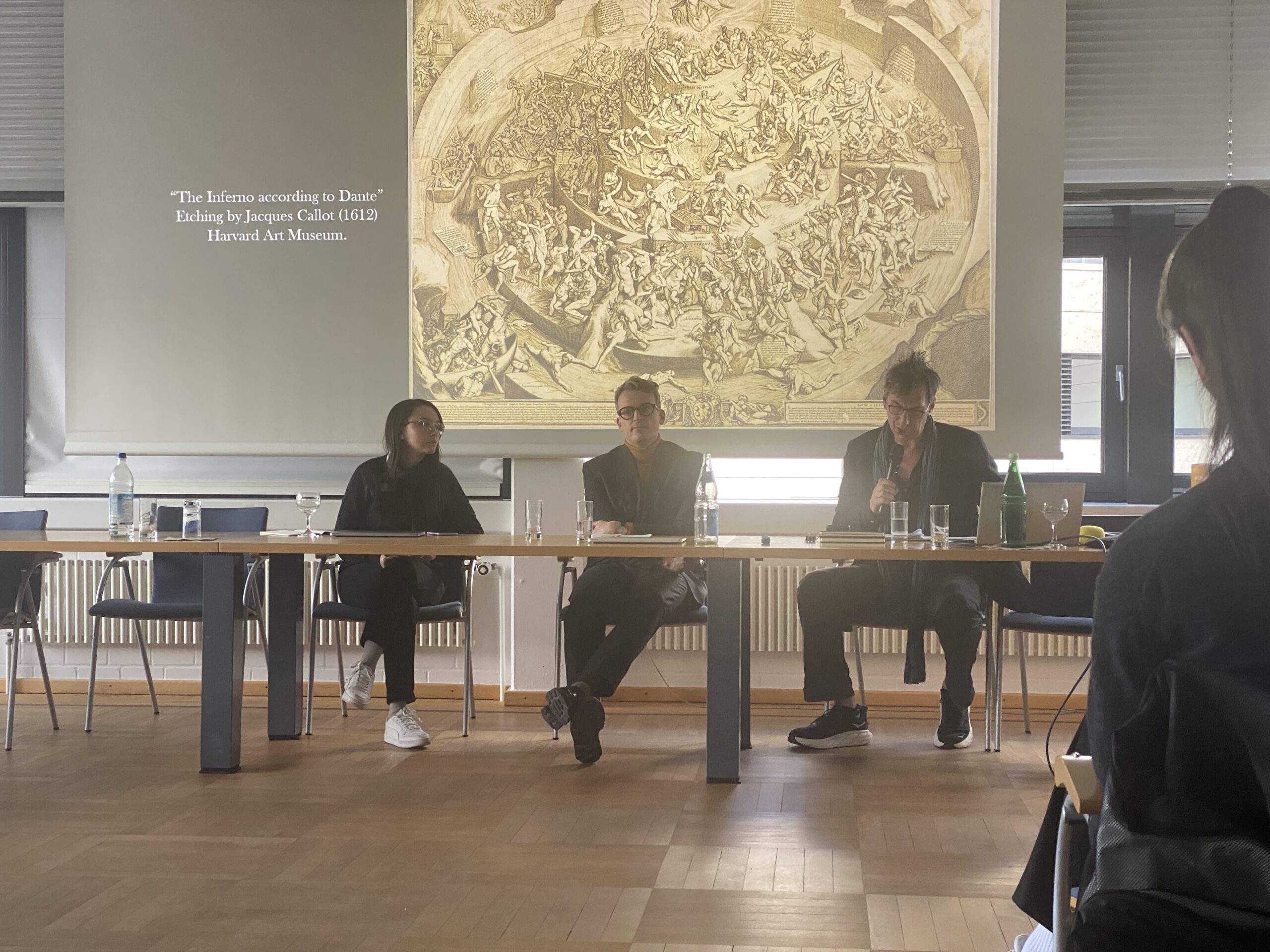
The Association for Adorno Studies held its first-ever meeting in Germany this past May, hosted on the main campus of Universität Kassel. The venue’s distinctive post-industrial architecture—interwoven with green space and crossed by the Ahne river—provided a striking setting for a conference dedicated to the theme “Adorno and Marx.”
We were warmly welcomed by our hosts Alexandra Colligs, Philip Hogh, and Hendrik Groß, to whom we extend our sincere thanks. By all accounts, the event was a great success. We are grateful to every speaker and chair for their thoughtful contributions and to all participants for making the trip to Kassel. The conference brought together scholars from Germany, Canada, Morocco, Turkey, United Kingdom and the United States, underscoring the global reach of Adorno studies today.
As per tradition, the AAS business meeting took place during lunch on the second day. The primary item on the agenda was the election of a new Vice-President. I am delighted to announce the election of Alexandra Colligs to this role. Her commitment to the Association has already been exemplary, and I look forward to deepening the collaboration we’ve built over the past year.
As for next year’s meeting: while it was originally planned to be held at Harvard under the auspices of Peter Gordon, current political pressures on academic institutions in the U.S. have made it impossible for any American host to commit with certainty. We will announce developments regarding next year’s venue as soon as they are confirmed.
As the readers of this blog know, the 10th meeting of the Association for Adorno Studies was held on May 30-31. The event took place on the beautiful “Pôle Citadelle” campus of the Université de Picardie Jules Verne, in Amiens, France. We owe the stunning design of the campus to the Italian architect Renzo Piano (see pictures below).
Our very heartfelt thanks go to Estelle Ferrarese and her team: Anne-Gaëlle Bled, Cassandre Caballero, Lea Gekle, Frederico Lyra, Annette de Moura and Salima Naït Ahmed, for the amazing work they did on planning and organizing this very successful meeting. This year the program was organized around a very timely theme in Adorno studies: “History and Social Theory”. It brought together a host of excellent scholars, several of whom are emerging scholars or new to the Association. Our thanks to all the presenters for their very thought-provoking and high-caliber papers on various aspects of Adorno’s views on the theme and to all the other participants who chaired sessions and partook in the lively discussions throughout the event. We counted participants from France, Italy, Belgium, Germany, the Netherlands, Sweden, Brazil, the UK, Canada and the US at this event.
As is our custom, the business meeting was held on the second day at lunch time. The main order of business was the election of a new executive. I am thrilled to announce that William Ross has accepted the role of President and Paul Dablemont that of Vice-President for a term of 3 years. Let us all thank them for their commitment to the AAS, congratulate them very warmly on their nomination and wish them the best for a very successful tenure!
Three other points of business are worth highlighting:
First, the Harvard meeting (to be hosted by Peter Gordon) has been pushed to the spring of 2026. William and Paul have been at work on a plan for 2025. They will be in touch with news about it over the summer.
Second, you can now forward information to be posted on the blog directly to William and Paul (follow the links above). They will be taking over the administration of this blog (at least until further notice).
Third, stay tuned for news about the relaunch of our journal, Adorno Studies, at Mimesis Press. It promises much!
I attach some pictures that document the event. They include pictures of the enchanting floating gardens (The Hortillonnages), a tour of which Estelle and her team had the marvellous idea to organize for us.
The 9th annual meeting of the Association for Adorno Studies took place in the beautiful coastal city of Brighton, UK, in early May. The meeting was held over two days in the venues of the Leonardo Hotel (May 5th: Brighton Station; May 6th: Brighton Waterfront). It was the first time since 2019 that the AAS was able to hold its annual meeting. It was very exciting to reconnect in person and to see so many new speakers and participants join our adventure.
Our thanks go to the Centre for Social and Political Thought of the University of Sussex for hosting the event. A very special thanks to Gordon Finlayson and Marina Lademacher for all the work they invested in organizing this wonderful event with such a stimulating and high-calibre program! The meeting was very well attended (we counted over 45 participants) and convened speakers and participants from several countries, including the US, Canada, France, Germany, Italy, Greece and Brazil. Amongst other things, this year’s program offered a concentration of remarkable papers on Adorno’s aesthetics and philosophy of music, which made for a very sustained and thought-provoking conversation over two days. The last day ended with a much-anticipated author-meet-critics panel devoted to Iain Macdonald’s What Would Be Different. Thanks to Taylor Carman, Peter E. Gordon, Iain Macdonald and Nick Walker for the fascinating exchanges!
We held our business meeting on the second day of the event at lunch time, as is our custom. While members of the AAS met a number of times more or less informally during our pandemic hiatus, this was our first formal business meeting since 2019. Surti Singh (President) and Pierre-Francois Noppen (Vice-President) co-chaired the meeting. They shared news about recent developments in the AAS and submitted a number of points for discussion. Significant changes have happened over the last three years. And we have many people to thank for their help and their efforts in making these changes possible. Here’s an overview:
First, Martin Shuster and Kathy Kiloh (founders of the AAS, former President and Vice-President of the AAS, respectively, as well as founders and editors Adorno Studies since its inception) stepped down from the journal in 2021. We owe an enormous debt of gratitude to both of them for their long and dedicated service and their extraordinary commitment to the AAS. Since then, a new editorial team has formed (Samir Gandesha, Johan Hartle, Antonia Hofstätter, Han-Gyeol Lie and Stefano Marino) along with a new editorial board. The new editors have been very busy preparing the relaunch of Adorno Studies at Mimesis Press. Antonia Hofstätter, who was present at the meeting, relayed some very exciting news (and shared some visuals!) about the next issue. Stay tuned! The event will be publicized on this blog.
Second, the AAS has been working on the transfer of this blog to a new server at UC Berkeley (thanks to Robert Kaufmann, Debarati Sanyal and Dan Blanton). The details should be announced soon. In the meantime, if you wish to be added on the mailing list of this blog, please contact Pierre-François Noppen directly (pf.noppen@usask.ca).
Third, we have announced that our executive is to be renewed at our 2024 meeting. It is worth noting that, on the model we agreed upon in 2012 at our first meeting (Johns Hopkins University), members of our executive serve three-year terms. While the pandemic upset our plans for a renewal of the executive, we are pleased to return to our pre-pandemic model with three-year commitments.
Fourth, we discussed a number of options for next year’s meeting (2024). The location will be announced by the end of the summer on this blog. We are also thrilled to announce that Peter E. Gordon has very graciously agreed to host our 2025 meeting at Harvard University.
All of this bodes very well for the future of the AAS!
Here’s the complete schedule of this year’s meeting.
And here are some pictures that were shared with us:
On April 26th and 27th 2019, the Association for Adorno Studies convened its 8th annual meeting at the University of São Paulo’s beautiful campus. The meeting was officially opened with remarks by host Vladimir Safatle, Surti Singh, and Pierre-François Noppen. It was the Association’s first meeting in Latin America and a welcome exposure to Adorno studies in Brazil. The well-attended meeting featured a strong program with speakers from Brazil, Canada, Egypt, Portugal, the United Kingdom, and the United States of America. The papers included excellent engagements with Adorno’s philosophy and aesthetics, as well as timely inquiries into the relevance of Adorno’s thought for current social and political issues.
Amid threats to academic freedom and invectives against cultural Marxism, our meeting coincided with Bolsonaro’s April 26th announcement on twitter that budgetary cuts would directly target philosophy and sociology. With the humanities facing an uncertain future, and colleagues and students in a dubious position, the meeting embodied a spirit of solidarity. Subsequently, a 30% cut to all university budgets was announced and the situation remains precarious today, with some universities uncertain about how they will conclude their current semesters.
During our business meeting, held on the second day, we discussed the general aims of the Association, possibilities for publication in the Association’s journal, Adorno Studies, plans for next year’s meeting with several options in Europe, and the future possibility of returning to Latin America.
On behalf of the entire Association, we’d like to extend our heartfelt thanks to Vladimir Safatle and Eduardo Socha for being such generous hosts, navigating us through the fascinating city of São Paulo, and for all their work and organization into making this yet another successful and productive meeting.
The 3rd annual meeting of the Association for Adorno Studies was held March 7th and 8th, 2014 at University College Dublin in Ireland. The meeting was convened at the beautiful Newman House, and was officially opened with remarks by host Brian O’Connor, Martin Shuster, and Kathy Kiloh. Continue reading →
The 2nd meeting was held at Temple University on the 22nd and 23rd of March. The meeting was officially opened with remarks by Espen Hammer and Martin Shuster. The two-day event was well attended by members from Temple, the New School, University of Pennsylvania, and surrounding schools (not to mention scholars from all over the world).
The papers given were again of extremely high quality, as was the level of discussion. A spirited round table was held again on the second day, that saw the participants grappling with how to pursue critical theory within practical contexts.
Many thanks to Espen Hammer and Temple University.
The next meeting will be hosted by Brian O’Connor, at University College Dublin, Ireland.
Photo of ‘Teddy’s Bitter’s’ courtesy of Gordon Finlayson, who tracked this menu down in Philadelphia.
A belated update…but the Association has been hard at work on the journal. To recap, the inaugural meeting of the Association for Adorno Studies was held at the Johns Hopkins University on March 2nd and 3rd, 2012. The meeting was officially opened with remarks from the meeting’s organizers and association co-founders, Kathy Kiloh and Martin Shuster. The two-day event was well attended by members of the Johns Hopkins community and scholars from all over the world.
The papers given were of extremely high quality, as were the question and answer sessions, and ultimately the level of engagement of all participants was outstanding. Continue reading →




![DSCN0399[1]](https://i0.wp.com/www.adornostudies.org/wp-content/uploads/2013/05/dscn03991.jpg?ssl=1)